











Chinese cooling appliances see strong demand in Europe
GoChina
2026.07.27 10:42:12 字號:
字號:
Recent summer heat waves sweeping across Europe have driven up demand for Chinese-made air conditioners and other cooling appliances.
At the air conditioner production base of Chinese home appliance giant Midea in Nansha district, Guangzhou, south China's Guangdong Province, portable split-type air conditioners move steadily along assembly lines as forklifts shuttle between warehouses and loading docks.
"Dedicated production lines are running at full tilt to meet overseas demand," said Xiong Xueqin, sales director of Midea RAC Europe Region.
On July 10, the X8120 China-Europe freight train departed Guangzhou International Port on schedule, carrying 55 containers of air conditioners and other appliances bound for Europe. Zheng Puyang, an executive at the port, said priority is given to assembling, grouping and dispatching portable air conditioner shipments to ensure fast and reliable delivery.
From April to June, China Railway Guangzhou Group Co., Ltd. shipped portable air conditioners and key components worth about $52 million via China-Europe freight trains, with more than 100,000 complete units dispatched.
As Europe faces prolonged high temperatures, Chinese-made portable split-type air conditioners have become hot sellers.
The penetration rate of air conditioners in European households remains low for several reasons: many buildings are protected historic structures where drilling into exterior walls is legally prohibited; installations in ordinary apartments require approval from homeowners' associations, a process that can take months; and licensed technicians typically charge 1,000 to 2,000 euros per installation—often more than the appliance itself.
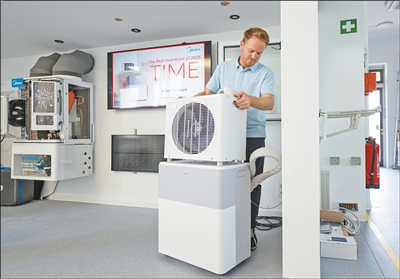
Zhao Ali, product manager of Midea RAC Europe Region, said the company's portable split-type air conditioners address these pain points with a window-mounted design that allows consumers to install them in 10 minutes without professional help.
Jointly developed by domestic and overseas research teams, the air conditioners house the compressor internally while the outdoor component is compact and lightweight enough to fit standard European window sizes, paired with a localized bracket design for tool-free installation.
Midea's overall air conditioner sales in Western Europe rose more than 70 percent year on year in the first half of this year, with sales of the portable split unit alone topping 60,000 in Germany. Full-year sales across Europe are projected to reach 200,000 to 300,000 units.
To keep pace with orders, Midea has arranged overtime production and relies on China-Europe freight trains, which take 15 to 25 days—about 25 days faster than sea freight.
Air conditioners aren't the only products sending a "cool breeze" to Europe. Inside the production workshop of Ningbo Hicon Industry Technology Co., Ltd. in Ningbo, east China's Zhejiang Province, a compact ice maker rolls off the line every 15 seconds, from final assembly to automatic packaging. Now in July, even though the peak shipping season has already passed, the company's production lines remain busy, turning out about 25,000 ice makers a day.
Ice makers fresh off the line are loaded onto trucks and packed into containers. "On a normal day we handle over 20 containers, and about a quarter of them are bound for Europe," a shipping dispatcher said. According to Zheng Li, the company's international trade director, exports to Europe have grown from 5 percent last year to 15 percent between January and May this year.
Company chairman Chen Yuepeng attributed the ice maker industry's rapid growth to a complete local supply chain: in Cixi, a county-level city in Ningbo, all the parts needed to build a small appliance can be sourced within two hours. Since 2006, the company has worked with compressor suppliers in several places to develop smaller, redesigned compressors that boost ice output despite their reduced size. The company's new ice maker this year is smaller still but produces a batch every six to eight minutes using only 95 watts—qualities Zheng said appeal most to European buyers.
Data from Ningbo Customs show the city exported electric fans, refrigerators, air conditioners, ice makers and other cooling appliances worth 2.73 billion yuan (about $403 million) to Europe from January to May, with ice maker exports up 36.8 percent year on year. Hicon alone holds 31 percent of the global market for household ice makers.
In Yiwu, Zhejiang Province, the city's cross-border e-commerce transactions reached 81.18 billion yuan in the first five months of the year, up 10.23 percent year on year, with exports of portable air conditioners and fans to Europe rising more than 70 percent from the same period last year—making cooling products a key driver of export growth, according to the Yiwu Cross-Border E-Commerce Association.

評論