











C919 prepares for 1st regular intl flight
GoChina
2026.07.21 09:29:01 字號:
字號:
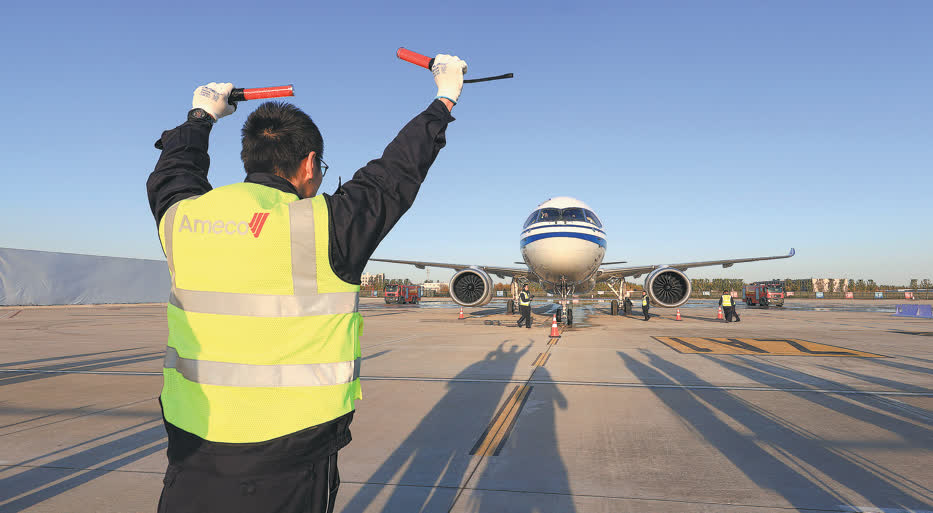
The C919, China's domestically developed narrowbody passenger jet, will begin its first scheduled international commercial service next month, a step industry experts said will test the aircraft's ability to operate beyond domestic markets and help build confidence for wider overseas expansion.
The daily round-trip service, operated by Air China, will connect Beijing Capital International Airport and Ulaanbaatar's Chinggis Khaan International Airport in Mongolia from Aug 12, the airline said.
According to the schedule, outbound flight CA723 will depart Beijing at 3 pm Beijing time and arrive in Ulaanbaatar at 5:15 pm local time. The return flight, CA724, will leave Ulaanbaatar at 6:30 pm local time and arrive in Beijing at 8:35 pm Beijing time.
The route marks the first time the C919, manufactured by Commercial Aircraft Corp of China, will enter a regular international commercial passenger aviation market.
Previously, the aircraft has operated mainly on Chinese mainland routes, as well as services connecting the mainland with the Hong Kong Special Administrative Region. China Eastern Airlines launched the aircraft on scheduled flights between Shanghai and Hong Kong in January 2025, while Air China began regular C919 services between Beijing and Hong Kong in November.
"Choosing Ulaanbaatar as the first regular international destination is not a move to lower the entry barrier or test the waters," said Zhu Keli, founding director of the China Institute of New Economy.
Zhu said the decision reflected a combination of factors including aviation cooperation between China and Mongolia, airworthiness cooperation arrangements, operational safety and route economics.
"China and Mongolia have maintained stable civil aviation cooperation, with a relatively mature framework for airworthiness cooperation," Zhu said. "The airport environment is relatively straightforward, the flight distance is moderate and the aircraft can complete a round trip within a day, allowing domestic technical support to respond quickly if operational issues arise."
The route also has established business and tourism demand, making it suitable for regular commercial operations rather than serving only as a demonstration flight, Zhu said.
He said the first international route is aimed at validating the full process of cross-border operations, including overseas maintenance support, international air traffic coordination and customs procedures.
"Ulaanbaatar is more like a low-risk practical training ground where the C919 can accumulate real overseas operating data and build a replicable model for future international expansion," Zhu said.
Guo Jia, a civil aviation expert and professor at Guangdong University of Foreign Studies' South China Business College, said safety considerations were the primary factor behind the selection of the first international destination.
He said Air China's previous experience operating the C909 regional jet to Ulaanbaatar, along with the airline's assessment of airport handling and maintenance capabilities, also supported the route choice.
For the Chinese aviation industry, the significance of the route extends beyond the flight itself, experts said.
"Previously, C919 operations were mainly based on China's domestic airspace and supporting infrastructure," Zhu said. "This scheduled international route means the aircraft is entering a regular commercial passenger aviation system between countries."
The operation will help establish overseas support capabilities, including maintenance cooperation, spare parts arrangements and international operating procedures, Zhu said.
Guo said international expansion would require more than aircraft performance. "Aircraft sales, international operations and market expansion all need to comply with the airworthiness standards of different countries and regions," Guo said, adding that broader international communication and certification efforts would be necessary.
Guo added that overseas maintenance, aircraft support and route support capabilities would be among the key challenges for international operations.
Looking ahead, experts expect the C919's international expansion to be gradual. "C919's internationalization will not follow an aggressive model of rapidly launching a large number of routes," Zhu said.
After validating operations in Ulaanbaatar, the aircraft will likely expand first into short-haul international markets in Central Asia and Southeast Asia, allowing it to accumulate experience under different operating conditions, Zhu said.
"The priority is to complete the transition from zero to one — making the first international route operate safely and accumulating experience," Guo said. "Only after establishing overseas safety operation and maintenance standards should the C919 move from one route to multiple routes.
"Airworthiness certification is indeed one of the biggest barriers for the C919 entering mainstream European and US markets," Zhu said.
He said certification by authorities such as the European Union Aviation Safety Agency and the US Federal Aviation Administration would be essential, while airlines' familiarity with the aircraft, maintenance networks, leasing systems and market recognition would also influence adoption.


評論