











China successfully recovers Long March 10B rocket following maiden flight, marking a breakthrough in rocket reusability
GoChina
2026.07.10 19:33:03 字號:
字號:
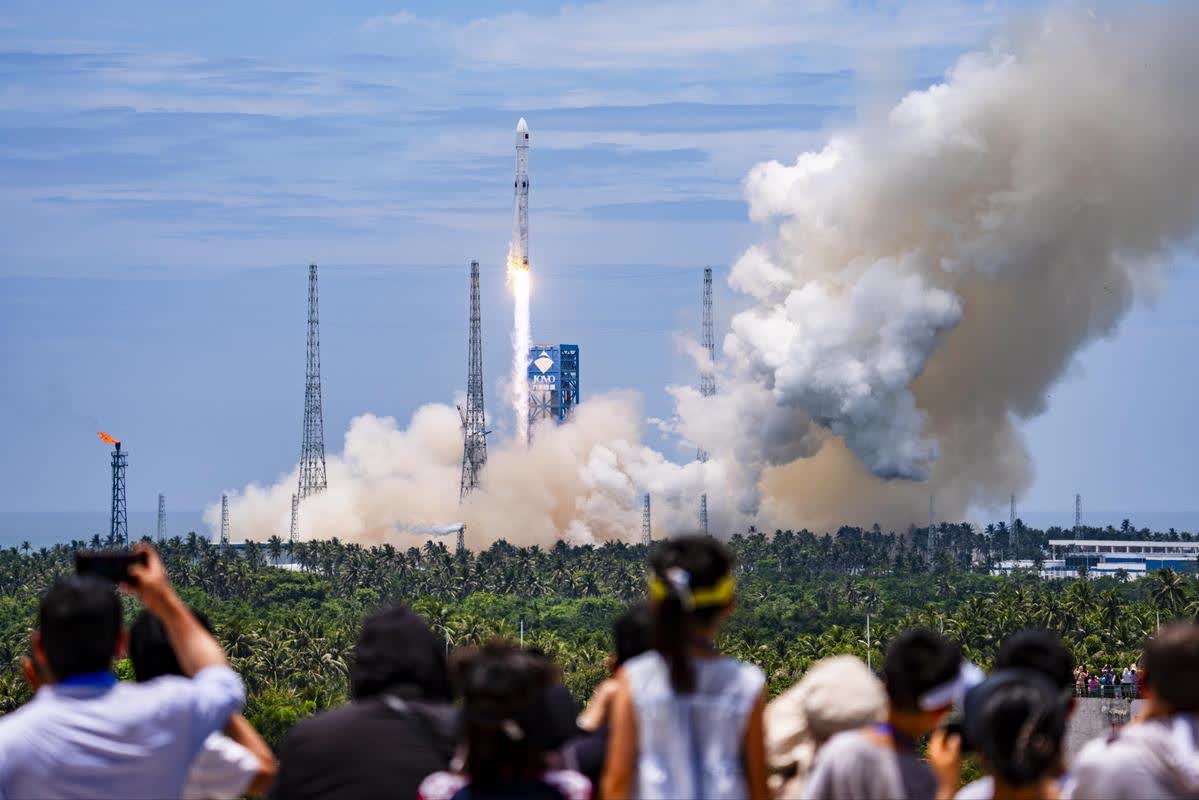
The Long March 10B, China's newest rocket model, made history on Friday as the first Chinese launch vehicle to be successfully recovered after an orbital mission.
The rocket's maiden flight made China the second country, after the United States, to own reliable rocket reusability technology. It also marked the world's first recovery of an orbital-class rocket using a wire arrestment recovery system.
At 12:15 pm, seven engines on the Long March 10B's first-stage booster roared to life, burning liquid oxygen and kerosene and lifting the 63.6-meter-tall rocket off a service tower at the Hainan International Commercial Aerospace Launch Center in Wenchang, a coastal city in Hainan province.
The rocket pierced through white clouds, leaving a trail of vapor against the bright sky.
After roughly two and a half minutes, the vehicle reached the separation point several kilometers above the Karman Line, the globally recognized boundary between Earth's atmosphere and outer space, where its first- and second-stage boosters separated and the first-stage engines cut off temporarily.
A single liquid oxygen-methane engine on the second stage then ignited, propelling the payload-carrying upper stage toward its target orbit. The stage later deployed a satellite into its preset orbit hundreds of kilometers above Earth.
Meanwhile, the first stage continued coasting upward briefly by inertia. Its grid fins unfolded and the reaction control system activated to adjust attitude and fine-tune its trajectory, before it began a controlled descent back into the atmosphere.
During the descent, select engines on the first stage reignited twice in sequence. Working in tandem with the grid fins and reaction control system, the engine burns slowed the stage's fall, kept it on its intended flight path, and reduced its speed as it neared the sea surface.
Between engine burns, the booster relied on a carefully calculated falling position to let air resistance bleed off speed.
Meanwhile, a recovery ship named Linghangzhe, or Pathfinder, waited at the predetermined recovery site hundreds of kilometers southeast of Wenchang, continuously tracking the returning first-stage booster and adjusting its position to maintain optimal alignment.
In the final seconds of the intricate maneuver, all engines on the first stage cut off, and a set of specialized metal hooks deployed to engage with the tensioned cable net.
Designed and built by the China Academy of Launch Vehicle Technology, a Beijing-based subsidiary of China Aerospace Science and Technology Corp, the Long March 10B is the third in the Long March 10 series of rockets built on technologies developed for the Long March 10A.
Globally, the best-known reusable rocket is SpaceX's Falcon 9, which has made many launches with reused boosters.
Blue Origin, another commercial space firm in the United States, has also completed its first successful landing of the first stage of its New Glenn rocket in a recent mission.
The Long March 10B first-stage recovery attempt marked China's third such attempt, following those made by the ZQ 3, developed by commercial firm Landspace, and the Long March 12Aby CASC's Shanghai Academy of Spaceflight Technology.


評論