











China's glass sector advances with technology, sustainability
GoChina
2026.04.27 17:35:12 字號:
字號:
Innovative products from China Yaohua Glass Group Co., Ltd. (Yaohua Glass) drew a steady stream of visitors at this April's China International Glass Industry Technical Exhibition in Shanghai.
The story of Yaohua Glass, a subsidiary of China National Building Material Group Co., Ltd., stretches back more than a century. Founded in Qinhuangdao city, north China's Hebei Province, in 1922, the Yaohua Glass Factory was Asia's first plant to use continuous mechanical production, earning it the title of "the cradle of China's glass industry."
From its first machine-made flat glass in 1924 to today's portfolio spanning automotive, energy-efficient and special glasses, Yaohua Glass stands as a microcosm of the sector's shift toward diversification and high-end production.
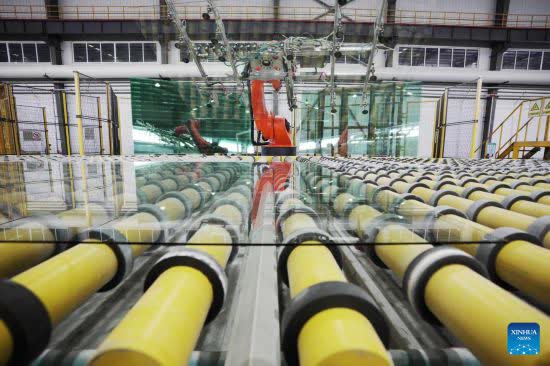
China is the world's largest glass producer and consumer, accounting for more than 60 percent of global output. During the 14th Five-Year Plan period (2021-2025), the industry kept pace with evolving market demands and steadily improved process technology.
Data from the China Building Materials Federation show that sales revenue from technical glass in 2025 was 46 percent higher than in 2020, reaching roughly four times that of primary flat glass.
Over the years, China's glass industry has grown from strength to strength, with companies making leapfrog advances in core technologies, product quality and supply chain integration.
In 1949, only three factories — located in Qinhuangdao, Dalian and Shenyang — produced flat glass in China, with a combined annual output of 912,000 weight cases, or about 1.7 percent of the global total. During the 14th Five-Year Plan period, annual production had stabilized at between 970 million and 1.02 billion weight cases, accounting for more than 60 percent of global output and representing a more than 1,000-fold increase compared with the early years of New China.
The road to that position was not without challenges. In 1964, China sent a delegation abroad to explore acquiring float glass technology, a process that produces smooth, uniform sheets by floating molten glass on a bed of molten tin. The delegation was turned away, with the other side refusing to share technical details and even declining requests to purchase samples.
Undeterred, the delegation returned home and focused on independent research. After six years of hard work, China's first float glass production line went into operation in 1971, giving rise to the "Luoyang float glass process," now recognized as one of the world's three major float glass technologies.
In 2018, a 0.12-millimeter electronic touch-control glass sheet rolled off the line — the thinnest ever produced using industrialized float technology at the time.
Sun Xingshou from the China Building Materials Federation noted that China's glass industry, backed by advanced technology and equipment, has strengthened its global competitiveness.
Chinese companies now account for more than 90 percent of international engineering, procurement and construction contracts for glass plants worldwide, with exports accounting for over 15 percent of total output and the value-added content of those exports continuing to rise.
The domestic market, however, presents its own challenges. Changes in the real estate market have intensified the imbalance between supply and demand for traditional architectural glass, while competition in segments such as float glass and photovoltaic glass has become increasingly fierce. In response, Chinese glass companies have stepped up efforts to diversify their products and advance their technology.
China's glass consumption underwent a historic structural shift during the 14th Five-Year Plan period. The share of flat glass used in construction fell below 50 percent in 2023 and further to under 40 percent by 2025, while industrial applications accounted for more than 60 percent of total consumption that year.
During the 15th Five-Year Plan period (2026-2030), the sector will focus on cultivating new market segments, expanding deep-processed glass and broadening demand across photovoltaics, new energy vehicles, electronics and green building, Sun said. The aim is to consolidate diversification, reduce homogeneous competition and enhance companies' competitiveness and profitability.
The sector's digital and intelligent transformation is well underway. Mature production techniques are enabling companies to shift toward flexible manufacturing, better suited to diverse order requirements.
Sustainability is also gaining importance: the industry has accelerated energy-saving and carbon-reduction upgrades, expanded the use of clean fuels such as natural gas, promoted distributed photovoltaic power generation, and boosted waste heat recovery. As a result, carbon emission intensity per weight case of flat glass fell by more than 4 percent in 2025 compared with 2020.
"With the help of artificial intelligence, the 15th Five-Year Plan period holds strong potential to support the development of more high-end glass products and green, low-carbon equipment," Sun said.


評論