











Resilient supply chains convince multinationals to take root in China
GoChina
2026.04.25 09:56:03 字號:
字號:
In the Louis Dreyfus Company (LDC) workshop in north China's Tianjin Municipality, tonnes of beige soybean meal moved along a highly automated production line as it transformed into bags of specialized feed protein after multiple processes.
With an annual capacity of 60,000 tonnes, this production line, which began operations last November, is LDC's first global production line for specialized feed protein. During the first three months after its launch, the company managed to establish cooperative relationships with about 20 partners worldwide.
"Tianjin has a world-class port and advanced warehousing and logistics networks, greatly facilitating the import of raw materials and product distribution for us. Our cooperation with local enterprises further strengthened the company's supply chain resilience," said Chen Jiayuan, CEO of LDC North Asia.
In his view, China's highly resilient industrial chain offers unprecedented opportunities for multinational companies.
The Europe-headquartered LDC, a global merchant and processor of agricultural goods, plans to continuously expand investment in the Chinese market in the future, according to Chen.
In recent years, the highly resilient industrial chain provided by the Chinese market has become a major attraction for multinationals. Aerospace companies, which rely heavily on global supply chains, cast their votes via investments, making significant commitments in China.
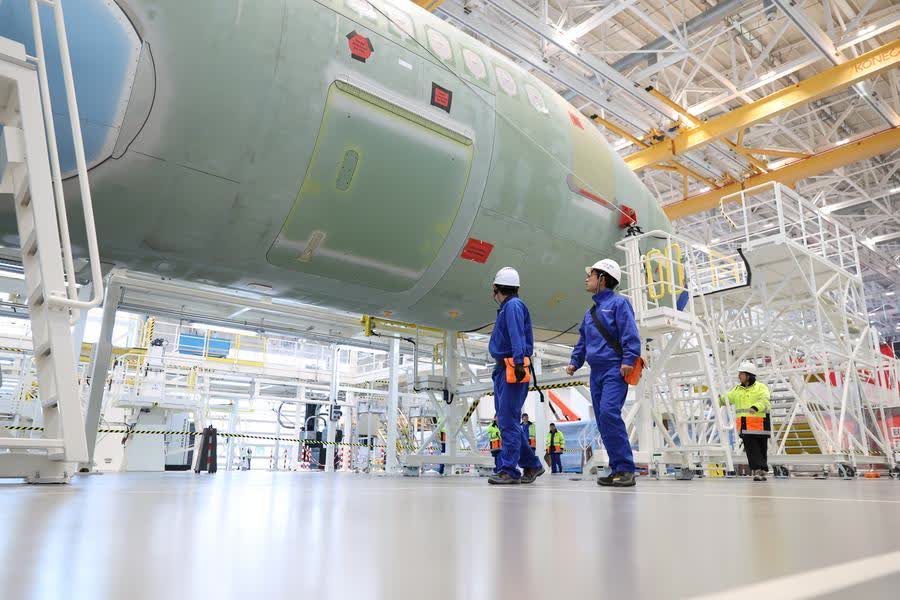
Last October, Airbus inaugurated its Final Assembly Line (FAL) for the A320 family aircraft in Tianjin, the second of its kind in both China and Asia as a whole. The Airbus A320 family production network now features a total of 10 FALs, with assembly capacity in Tianjin set to contribute 20 percent of the company's total globally.
Such investment in China has demonstrated the company's confidence in the country's booming aviation market, robust supply chain and friendly business environment, said Airbus CEO Guillaume Faury.
Approximately 200 Chinese suppliers now support Airbus' commercial aircraft production efforts, covering the entire industrial chain from raw materials to system assembly, a key factor that gave Airbus the confidence to establish an additional assembly line in China.
Similarly, in Boeing Tianjin Composites Co., Ltd. (BTC), nearly half of production materials are from Chinese domestic suppliers, with these products renowned for their high safety and quality standards within Boeing's global supply network.
Marcus Williams, vice general manager of BTC, said China had a relatively complete aviation industry chain system, and the country's open and inclusive market environment made it a place suitable for long-term investment.
"China is very attractive for global investors," noted Victor Chu, chairman of First Eastern Investment Group, which has invested in Tianjin for many years. Chu added that Tianjin has all the ingredients of industrialization, like high-level research and development, advanced manufacturing and a big market. The company will increase involvement in Tianjin and attract more international partners to the city, Chu said.
He Zhiyi, chief expert at the Institute for Global Industry, Tsinghua University, highlighted that every country has its own competitive industries. While multinational corporations achieved mutual benefits through exchange and cooperation, China, with its open and inclusive market environment and resilient supply chain system, provides an ideal platform for such collaboration.
China is the only country in the world with a complete industrial system. Foreign-invested companies in China benefit from shorter duration, greater convenience and lower costs in accessing industrial chain support from upstream and downstream partners, giving them greater confidence and resilience in coping with global economic and geopolitical changes, said Wu Hongliang, an official with the National Development and Reform Commission.
During the 15th Five-Year Plan period (2026-2030), China will continue to expand high-level opening up, creating favorable conditions for multinationals to invest and operate in the country, Wu said.

評論