










Xi's pioneering heritage steps still resonate
GoChina
2026.04.14 09:11:57 字號:
字號:
Over four decades ago in Zhengding, a county in Hebei province better known for cultural heritage than economic dynamism, Xi Jinping, at the start of his political career, pursued a set of priorities that were outside the conventional playbook of economic development.
He moved to halt the making of rubbings from a weathered stone monument, a practice that had been slowly eroding its surface. He asked officials to identify and protect centuries-old trees that had long gone uncounted. And when an opportunity arose to host the filming of a major television drama, he argued against building a temporary set, insisting instead on a permanent structure that could outlast the production itself.
At a time when local governments across China were under pressure to generate growth quickly — often through factories, construction and output―— such decisions stood apart and are still shaping the nation's development trajectory.
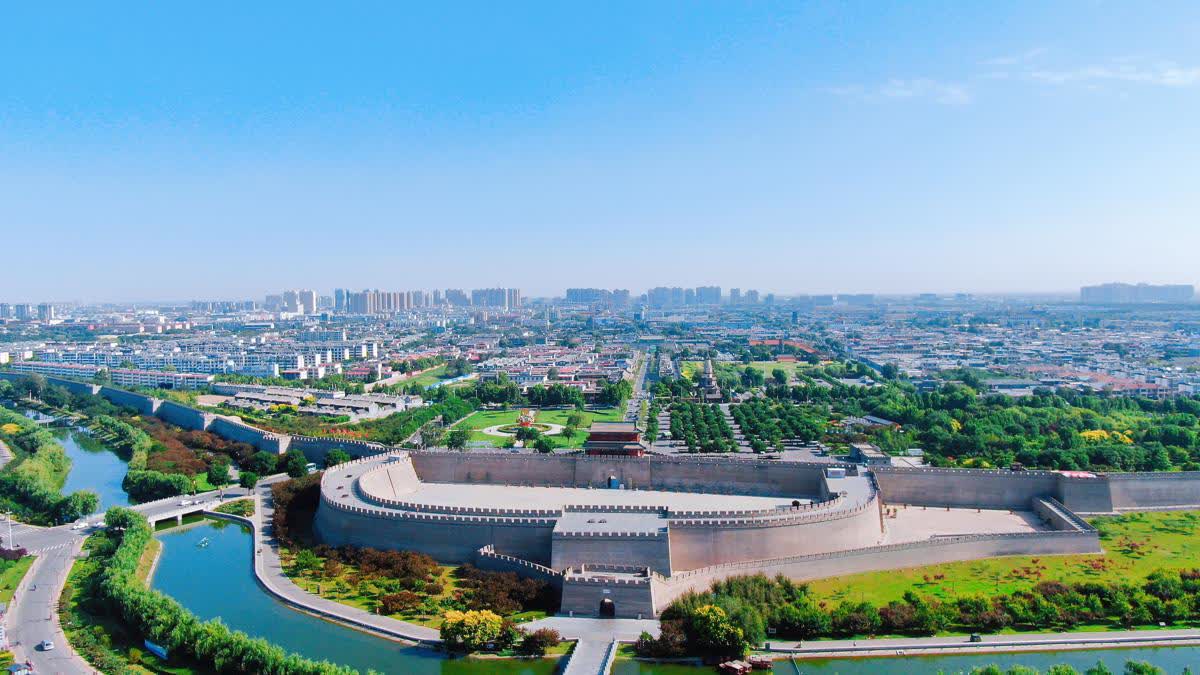
By 2025, the county was receiving over 50 million tourist visits annually, and its economy was anchored not by factories but by heritage — temples, walls and reconstructed courtyards that drew steady streams of visitors.
Xi arrived in Zhengding in 1982, at a moment when China's reform and opening-up were just beginning. Former colleagues say that Xi, who first served as the deputy Party secretary of the county before serving as the Party secretary during a three-year tenure, showed a foresight that went beyond his peers.
Within Zhengding's ancient town — described locally as a landscape of "nine towers, four pagodas and eight major temples" — he spent time examining buildings, inscriptions and structures that others often overlooked. Longxing Temple, one of the county's most important sites, became a particular point of attention.
Wang Zhimin, then an official who served in the general office of the Zhengding county Party committee, said Xi approached such places with a strong sense of responsibility.
"He had a deep personal commitment to culture," Wang said, recalling that Xi spent considerable time and energy on preservation work. "He personally went to the provincial Party committee and the provincial government to secure funding, and a number of cultural heritage sites were restored as a result."
That commitment became visible during an inspection of the Longzang Temple Stele, a monument dating back to China's Sui Dynasty (581-618) that is widely regarded as a key milestone in the development of Chinese calligraphy.
The stone had been exposed to the elements for years. Repeated rubbings — a traditional method of copying inscriptions — had further eroded its surface.
"He ordered on the spot that no more rubbings should be made and that the stele be carefully preserved," Wang said.
The stele was elevated to prevent water damage caused by changes in ground level, and a protective pavilion was constructed. A replica was later installed, allowing public access without compromising preservation.
In another case, officials recalled, Xi encountered a stele by the renowned calligrapher Zhao Mengfu (1254-1322) lying exposed on the bare ground. He summoned the responsible officials and criticized the lack of protection, saying such treatment was unacceptable. The site was later upgraded with proper shelter.
"If we fail to safeguard our cultural relics, we would be guilty before future generations," he said, according to those present.
The same logic extended beyond monuments to living elements of the landscape.
Soon after arriving, Xi asked about two ancient locust trees in the county compound — when they had been planted, how old they were. No one could answer.
Zhu Bohua, then deputy director of the general office of the county Party committee, said Xi instructed officials to consult experts and conduct a broader survey. The effort identified 43 ancient trees more than 100 years old across the county. Each was tagged and placed under protection.
"One tree connects to the roots of the nation, to its cultural lineage, to its history," Zhu said.
If preservation defined one side of Xi's approach, another decision connected it to economic development.
In the mid-1980s, China Central Television was preparing a television adaptation of A Dream of Red Mansions. The production team had struggled to find a suitable filming location near Beijing. Xi proposed building one in Zhengding.
Gao Peiqi, who worked in the county's publicity system at the time, said the idea was controversial. The project would cost 3.7 million yuan ($542,000) — a large investment for a county with annual fiscal revenue of only about 12 million yuan.
But Xi argued that the set should not be temporary. "He believed this was a rare opportunity," Gao said. "If we missed it, it would not come again."
Construction of Rongguo Mansion began in December 1984 and was completed in July 1986. After opening, it attracted 1.3 million visitors in its first year, generating 2.21 million yuan in ticket revenue. Total tourism income for the county reached 17.61 million yuan.
When the television series aired in 1987, Zhengding quickly became a national tourist destination. Visitors arrived in large numbers, drawn by a combination of cultural familiarity and physical setting.
Wang Sugang, deputy head of Zhengding county, said the impact was immediate and far-reaching.
"With the broadcast of A Dream of Red Mansions, Zhengding became a destination for ordinary people," he said. "At the time, it was said that the streets emptied as everyone came to see it."
He described the period as the beginning of what local officials later called the "Zhengding model" — a pattern in which cultural resources were not only preserved but activated as economic drivers.
In the 1980s, during Xi's time in Zhengding, "he proposed developing the county through tourism", Wang Sugang said. "That strategy laid the foundation and set the direction for decades of development."
Xi, who is now Chinese president and general secretary of the Communist Party of China Central Committee, issued further instructions in 2013, emphasizing the importance of protecting Zhengding's ancient city and safeguarding its historical and cultural value. The guidance came at a time when rapid urbanization elsewhere in China had intensified debates over preservation and redevelopment.
Wang, the deputy head of the county, said the instructions helped clarify direction at a critical moment.
"At that time, there were different views on whether to prioritize development or protection," he said. "Those instructions made it clear — the historical and cultural value had to be preserved."
Between 2017 and 2019, Zhengding completed 24 conservation projects, restoring walls, temples and key historical sites. Wang said the results have been tangible.
"Now you can climb the city walls, see the ancient pagodas and feel the history," he said. "What used to be an idea has become something people can experience."
Du Ping, deputy director of the county's cultural relics conservation office, said the approach has remained consistent over time: preservation first, with careful integration into modern use.
New institutions, including the city wall museum, have brought cultural relics into everyday life. Archaeological sites, such as those near Kaiyuan Temple, are displayed behind glass, allowing visitors to observe without damaging fragile remains.
Visitors can walk along restored city walls, look out over ancient pagodas and move through neighborhoods where historical sites are integrated into daily life. Museums, cultural venues and public spaces allow residents and tourists to engage with the city's past in tangible ways.
"The changes didn't happen overnight," Wang Sugang said. "But once the direction was set, we kept moving forward."


評論